Fiecare activitate fizică zilnică menține sănătatea sistemului cardiovascular. Sistemul cardiovascular uman, care include inima și vasele de sânge, s-a adaptat pentru a funcționa în gravitația Pământului. Atunci când astronauții călătoresc în spațiu, corpurile lor încep să se adapteze la microgravitația navei lor spațiale. Sângele și alte fluide corporale, anterior trase în jos de gravitație, acum se deplasează către cap, astfel încât sistemul cardiovascular nu trebuie să lucreze atât de mult pentru a menține fluxul sanguin către creier. Această adaptare la lipsa de greutate poate duce la scăderea volumului de sânge și la reducerea funcției inimii și a vaselor de sânge.
Când astronauții se întorc pe Pământ, gravitația trage din nou fluidele corpului lor în jos. Sistemul cardiovascular este acum provocat să regleze tensiunea arterială, ceea ce determină ca unii astronauți să se simtă slabi, amețiți sau să leșine atunci când se ridică imediat după sosirea pe Pământ. Aceste simptome pot dura câteva zile până când se obișnuiesc să petreacă timp în gravitația Pământului.
Ceea ce învățăm în timp ce suntem la bordul stației spațiale are aplicații importante pe Pământ. Multe dintre schimbările observate în spațiu seamănă cu cele cauzate de îmbătrânire pe Pământ. Pe măsură ce îmbătrânim, în special dacă nu rămânem activi fizic, eficiența inimii și a vaselor de sânge de a menține tensiunea arterială în timp ce stăm în picioare poate scădea și unele persoane pot dezvolta boli de inimă. Deoarece petrecerea timpului în spațiu afectează inima și sistemul circulator, cercetarea de pe stația spațială examinează aceste efecte pe termen scurt și lung. Scopul cercetării este de a dezvolta și testa contramăsuri pentru adaptările cardiovasculare la zborul spațial pentru a beneficia atât astronauții, cât și oamenii de pe Pământ.
Un exemplu de studiu efectuat pe stație în domeniul cercetării cardiovasculare este investigația Vascular Echo a CSA (Canadian Space Agency), care a examinat schimbările în vasele de sânge și inimile membrilor echipajului spațial și a urmărit recuperarea acestora după întoarcerea pe Pământ. Prin utilizarea tehnologiei de ultrasunete 3D, echipajul a putut obține imagini detaliate ale vaselor de sânge, oferind o mai bună reprezentare decât imaginile 2D. Această tehnologie a permis echipajelor să obțină scanări de înaltă calitate, chiar dacă nu sunt neapărat experte în ecografie.
O altă investigație numită Fluid Shifts a demonstrat cât de mult fluid, inclusiv apă și sânge, se deplasează din partea inferioară a corpului în partea superioară în spațiu. Studiul a evaluat, de asemenea, impactul pe care aceste deplasări îl au asupra structurii și funcționării ochilor și creierului. Rezultatele au arătat că mai multe măsurători ale deplasării fluidelor către partea superioară a corpului au fost crescute în timpul zborului spațial, dar au fost reduse la nivelurile pre-zbor atunci când s-au folosit metode pentru inversarea acestor deplasări de fluide.
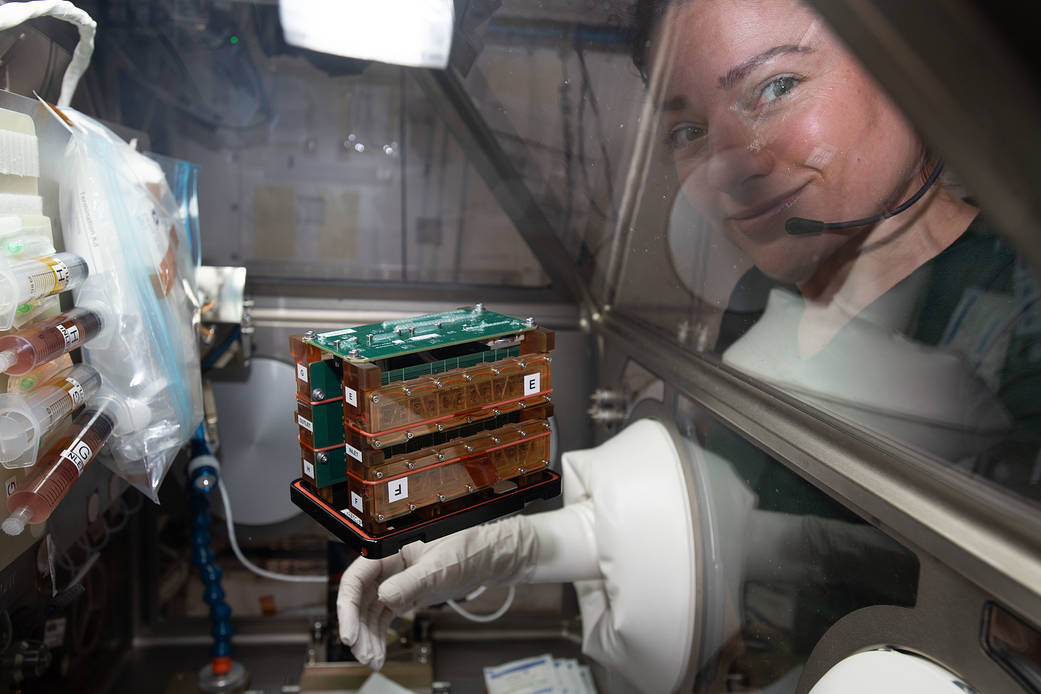
Studiile efectuate pe stația spațială folosesc deseori cipuri de țesut, dispozitive mici care imită funcțiile organelor umane. Aceste instrumente includ culturi 3D ale unor tipuri specifice de celule, țesuturi proiectate pentru a reproduce caracteristicile celulare specifice, precum și structuri 3D realizate din multe tipuri diferite de celule într-un organ anume, cum ar fi inima. Aceste înlocuitori pentru inimile reale permit noi tipuri de cercetare și testare a medicamentelor.
Un alt exemplu de studiu este Engineered Heart Tissues (EHT), care a folosit țesuturi 3D derivate din hiPSCs pentru a studia funcționarea cardiacă în microgravitație. Un senzor bazat pe magnet sub camera de cultură a permis analiza în timp real, nedistructivă a performanței funcționale și a maturizării țesuturilor în spațiu. Proiectul Engineered Heart Tissues-2 construiește pe proiectul său predecesor folosind culturi 3D de țesut muscular cardiac pentru a testa terapiile care ar putea preveni aceste schimbări.
Astfel, cercetările realizate pe Stația Spațială Internațională aduc contribuții semnificative în înțelegerea efectelor gravitaționale asupra sistemului cardiovascular și pot oferi soluții inovatoare pentru prevenirea și tratamentul bolilor de inimă, atât pentru astronauți, cât și pentru oamenii de pe Pământ.
Everyday physical activities keep the cardiovascular system healthy. The human cardiovascular system, which includes the heart and blood vessels, has evolved to operate in Earth’s gravity. When astronauts travel to space, their bodies begin to adjust to the microgravity of their spacecraft. Blood and other bodily fluids previously pulled downward by gravity now move toward the head, so the cardiovascular system doesn’t have to work as hard to maintain blood flow to the brain. This adaptation to weightlessness can result in reduced blood volume and reduced function of the heart and blood vessels.
When astronauts return to Earth, gravity once again pulls their body fluids downward. The cardiovascular system is now challenged to regulate blood pressure, causing some astronauts to feel weak, dizzy, or faint when they stand immediately upon arrival on Earth. These symptoms can last for a few days until they get used to spending time back in Earth’s gravity.
What we learn while aboard the space station has important applications on Earth. Many of the changes seen in space resemble those caused by aging on Earth. As we age, particularly if we don’t remain physically active, the efficiency of the heart and blood vessels to maintain blood pressure while standing may decrease and some people may develop heart disease. Because spending time in space affects the heart and circulatory system, research on the space station looks at these effects in both the short and long term. Research aims to develop and test countermeasures to cardiovascular adaptations to spaceflight to benefit both astronauts and people on the ground.
Below are some examples of studies performed on the station involving cardiovascular research.
Using 3D ultrasound technology, Vascular Echo, an investigation from CSA (Canadian Space Agency), examined changes in blood vessels and the hearts of crew members in space and followed their recovery upon return to Earth. 3D images of blood vessels using ultrasounds show more detail than 2D images, just like how a model car is a better representation than a flat picture of that car. Astronauts used a motorized ultrasound probe to scan crucial body parts. Meanwhile on the ground, scientists could adjust the angle of the ultrasound beam emitted by the probe to collect the best image possible. Using this technology allowed crews to collect high-quality scans even though they’re not necessarily expert sonographers.1
An investigation called Fluid Shifts demonstrated how much fluid—including water and blood—moves from the lower body to the upper body in space. The study also evaluated the impact these shifts have on the structure and function of the eyes and brain. Results showed that several measurements of body fluids shifting towards the upper body were elevated during spaceflight but were reduced to preflight levels when using methods to reverse these fluid shifts.2
An investigation completed in 2018, Cardiac Myocytes examined how stem cells differentiate into specialized heart cells (cardiac myocytes). The experiment evaluated cell maturation in microgravity and tested the ability of the cells to repair damaged heart tissues. This study advances the development of possible regenerative therapies for both astronauts and patients on Earth.
Subsequent experiments took advantage of microgravity’s effects on cell behavior and growth to create tools for further research, model disease, and test potential treatments for heart damage. MVP Cell-03 examined whether microgravity increased production of heart cells from human-induced pluripotent stem cells (hiPSCs). Pluripotent cells have started to differentiate, making them more specialized than stem cells, but they retain the ability to develop into multiple types of cells. Any observed increase in production of heart cells could make it possible to use cultured cells to help treat spaceflight-induced cardiac abnormalities and create personalized therapies to replenish heart cells damaged or lost due to disease on Earth. Project EAGLE, a related experiment, grows 3D cultures of heart cells in microgravity and could provide a heart tissue model that mimics heart disease and assesses potential drug therapies.
Many studies aboard the space station use tissue chips, small devices that mimic functions of human organs. These tools include 3D cultures of specific cell types, tissues engineered to reproduce specific cellular characteristics, as well as 3D structures made from many different cell types in a particular organ such as the heart. These stand-ins for actual hearts enable new types of research and drug testing.
Engineered Heart Tissues (EHT) used 3D tissues derived from hiPSCs to study cardiac function in microgravity. A magnet-based sensor underneath the culture chamber allowed real-time, non-destructive analysis of the functional performance and maturation of the tissues in space. Engineered Heart Tissues-2 builds on its predecessor using 3D cultures of cardiac muscle tissue to test therapies that may prevent these changes.
Cardinal Heart, a study using engineered heart tissues to understand effects of change in gravitational force on cardiovascular cells, confirmed that microgravity exposure causes significant changes in heart cell function and gene expression that could lead to damage.3 Cardinal Heart 2.0 took this research to the next level. It used a beating heart organoid containing different kinds of stem-cell-derived cardiac cells to test whether certain drugs can reduce or prevent microgravity-induced changes. Using tissue chips to test new drugs could help reduce the need for the animal studies required before clinical trials in humans, potentially shortening the time between the discovery of a drug candidate and its clinical use.
Andrea Lloyd
International Space Station Research Communications Team
Johnson Space Center
Search this database of scientific experiments to learn more about those mentioned above.
Citations
- Patterson C, Greaves DK, Robertson AD, Hughson RL, Arbeille P. Motorized 3D ultrasound and jugular vein dimension measurement on the International Space Station. Aerospace Medicine and Human Performance. 2023 June 1; 94(6): 466-469. DOI: 10.3357/AMHP.6219.2023.PMID: 37194183
- Arbeille P, Zuj KA, Macias BR, Ebert DJ, Laurie SS, Sargsyan AE, Martin DS, Lee SM, Dulchavsky SA, Stenger MB, Hargens AR. Lower body negative pressure reduces jugular and portal vein volumes, and counteracts the cerebral vein velocity elevation during long-duration spaceflight. Journal of Applied Physiology. 2021 September; 131(3): 1080-1087. DOI: 10.1152/japplphysiol.00231.2021.PMID: 34323592.
- Wnorowski, A., Sharma, A., Chen, H., Wu, H., Shao, N.-Y., Sayed, N., Liu, C., Countryman, S., Stodieck, L. S., Rubins, K. H., Wu, S. M., Lee, P. H. U., & Wu, J. C. (2019). Effects of spaceflight on human induced pluripotent stem cell-derived cardiomyocyte structure and function. Stem Cell Reports, 13(6), 960–969. https://doi.org/10.1016/j.stemcr.2019.10.006
Acest titlu a fost scris de inteligență artificială Chat GPT, unele date pot fi incorecte. Pentru stirea originala, verificati sursa: Link catre sursa
Sursa si foto: NASA
În plus, ar putea să-ți placă
Precizări: Legea 190 din 2018, la articolul 7, menţionează că activitatea jurnalistică este exonerată de la unele prevederi ale Regulamentului GDPR, dacă se păstrează un echilibru între libertatea de exprimare şi protecţia datelor cu caracter personal.
Mai multe gasiti pe pagina de
Facebook stiridinromania.ro!
Daca ati fost martorii unui eveniment sau ai unei situatii neobisnuite care ar putea deveni subiect de stire, contactati-ne la
admin @ stiridinromania.ro sau pe contul nostru de
Facebook stiridinromania.ro!