The technology behind the two seismometers that make up NASA’s Farside Seismic Suite was used to detect more than a thousand Red Planet quakes.
The most sensitive instrument ever built to measure quakes and meteor strikes on other worlds is getting closer to its journey to the mysterious far side of the Moon. It’s one of two seismometers adapted for the lunar surface from instruments originally designed for NASA’s InSight Mars lander, which recorded more than 1,300 marsquakes before the mission’s conclusion in 2022.
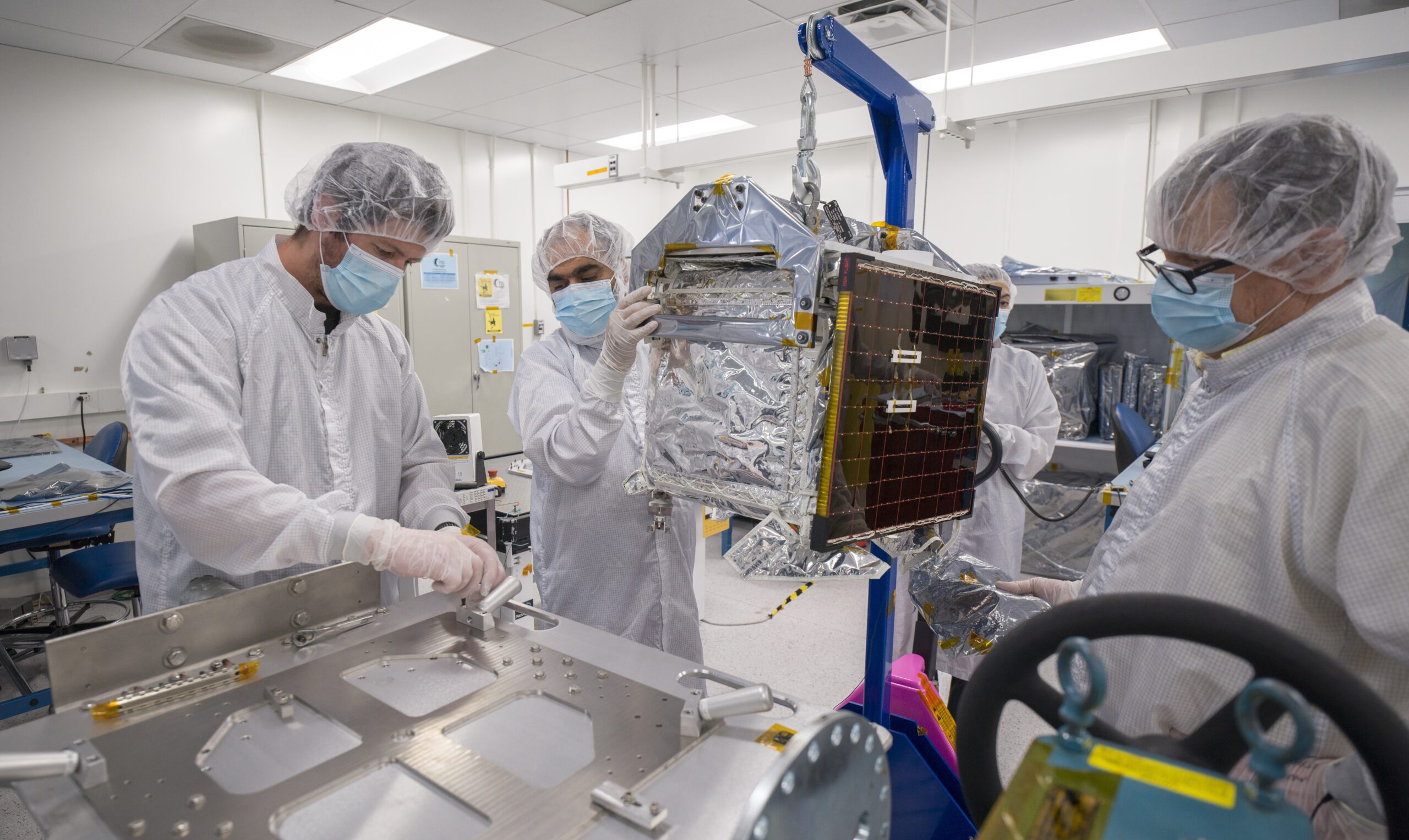
Part of a payload called Farside Seismic Suite (FSS) that was recently assembled at NASA’s Jet Propulsion Laboratory in Southern California, the two seismometers are expected to arrive in 2026 at Schrödinger basin, a wide impact crater about 300 miles (500 kilometers) from the Moon’s South Pole. The self-sufficient, solar-powered suite has its own computer and communications equipment, plus the ability to protect itself from the extreme heat of lunar daytime and the frigid conditions of night.
After being delivered to the surface by a lunar lander under NASA’s CLPS (Commercial Lunar Payload Services) initiative, the suite will return the agency’s first seismic data from the Moon since the last Apollo program seismometers were in operation nearly 50 years ago. Not only that, but it will also provide the first-ever seismic measurements from the Moon’s far side.
Up to 30 times more sensitive than its Apollo predecessors, the suite will record the Moon’s seismic “background” vibration, which is driven by micrometeorites the size of small pebbles that pelt the surface. This will help NASA better understand the current impact environment as the agency prepares to send Artemis astronauts to explore the lunar surface.
Planetary scientists are eager to see what FSS tells them about the Moon’s internal activity and structure. What they learn will offer insights into how the Moon — as well as rocky planets like Mars and Earth — formed and evolved.
It will also answer a lingering question about moonquakes: Why did the Apollo instruments on the lunar near side detect little far-side seismic activity? One possible explanation is that something in the Moon’s deep structure essentially absorbs far-side quakes, making them harder for Apollo’s seismometers to have sensed. Another is that there are fewer quakes on the far side, which on the surface looks very different from the side that faces Earth.
“FSS will offer answers to questions we’ve been asking about the Moon for decades,” said Mark Panning, the FSS principal investigator at JPL and project scientist for InSight. “We cannot wait to start getting this data back.”
Farside Seismic Suite’s two complementary instruments were adapted from InSight designs to perform in lunar gravity — less than half that of Mars, which, in turn, is about a third of Earth’s. They’re packaged together with a battery, the computer, and electronics inside a cube structure that’s surrounded by insulation and an outer protective cube. Perched atop the lander, the suite will gather data continuously for at least 4½ months, operating through the long, cold lunar nights.
The Very Broadband seismometer, or VBB, is the most sensitive seismometer ever built for use in space exploration: It can detect ground motions smaller than the size of a single hydrogen atom. A fat cylinder about 5 inches (14 centimeters) in diameter, it measures up-and-down movement using a pendulum held in place by a spring. It was originally constructed as an emergency replacement instrument (a “flight spare”) for InSight by the French space agency, CNES (Centre National d’Études Spatiales).
Philippe Lognonné of Institut de Physique du Globe de Paris, the principal investigator for InSight’s seismometer, is an FSS co-investigator and VBB instrument lead. “We learned so much about Mars from this instrument, and now we are thrilled with the opportunity to turn that experience toward the mysteries of the Moon,” he said.
The suite’s smaller seismometer, called the Short Period sensor, or SP, was built by Kinemetrics in Pasadena, California, in collaboration with the University of Oxford and Imperial College, London. The puck-shaped device measures motion in three directions using sensors etched into a trio of square silicon chips each about 1 inch (25 millimeters) wide.
The FSS payload came together at JPL over the last year. In recent weeks, it survived rigorous environmental testing in vacuum and extreme temperatures that simulate space, along with severe shaking that mimics the rocket’s motion during launch.
“The JPL team has been excited from the beginning that we’re going to the Moon with our French colleagues,” said JPL’s Ed Miller, FSS project manager and, like Panning and Lognonné, a veteran of the InSight mission. “We went to Mars together, and now we’ll be able to look up at the Moon and know we built something up there. It’ll make us so proud.”
A division of Caltech in Pasadena, California, JPL manages, designed, assembled, and tested Farside Seismic Suite. The French space agency, CNES (Centre National d’Études Spatiales), and IPGP (Institut de Physique du Globe de Paris) provided the suite’s Very Broadband seismometer with support from Université Paris Cité and the CNRS (Centre National de la Recherche Scientifique). Imperial College, London and the University of Oxford collaborated to provide the Short Period sensor, managed by Kinemetrics in Pasadena. The University of Michigan provided the flight computer, power electronics, and associated software.
A selection of NASA’s PRISM (Payloads and Research Investigations on the Surface of the Moon), FSS is funded by the Exploration Science Strategy and Integration Office within the agency’s Science Mission Directorate. The Planetary Missions Program Office at NASA’s Marshall Space Flight Center provides program management. FSS will land on the Moon as part of an upcoming lunar delivery under NASA’s CLPS (Commercial Lunar Payload Services) initiative.
More information about FSS is at:
https://go.nasa.gov/FSS
Melissa Pamer
Jet Propulsion Laboratory, Pasadena, Calif.
626-314-4928
melissa.pamer@jpl.nasa.gov
2024-074