Explorarea lui Curiozitate pe Marte

BY: stiridinromania.ro In Magazin
NASA Logo

Roverul Curiosity al NASA a creat o imagine a unei luni marțiene și a planetei Pământ folosind un proces de focalizare la bordul său. Cu ajutorul Mars Hand Lens Imager (MAHLI) de la bordul roverului, au fost combinate două până la opt imagini anterior realizate de MAHLI. Această combinație a fost efectuată pe 4 septembrie 2024, la sol 4294 a misiunii Mars Science Laboratory. Procesul de focalizare la bord este uneori realizat pe imagini obținute în aceeași zi sau folosind imagini mai vechi. Această metodă are rolul de a crea o imagine compozită a aceluiași obiect, realizată la diferite poziții de focalizare, pentru a aduce cât mai multe caracteristici posibile într-o singură imagine.

Această imagine compozită este folosită și pentru a reduce numărul de imagini trimise înapoi pe Pământ. Fiecare combinație de focalizare produce două imagini: o imagine color, cu cea mai bună focalizare și o imagine alb-negru pe care oamenii de știință o pot folosi pentru a estima poziția focalizării pentru fiecare element al imaginii cu cea mai bună focalizare. Astfel, se pot combina până la opt imagini, dar numărul de imagini trimise înapoi pe Pământ este doi.

Planificarea pentru ziua de 4 septembrie 2024 include blocuri obișnuite de știință, precum contactul științific și știința la distanță pentru a observa și evalua geologia din jurul roverului Curiosity. Echipa Mastcam speră să surprindă un eveniment special deasupra orizontului marțian, deoarece una dintre lunile lui Marte, Phobos, va fi în conjuncție cu Pământul în această perioadă.

În planul de astăzi, accentul este pus pe vizarea diferitelor culori și nuanțe pe care le putem observa în rocile de bază cu ajutorul instrumentelor noastre. De exemplu, instrumentul APXS vizat “Campfire Lake”, o zonă cu o nuanță mai deschisă, și “Gemini”, o zonă cu o nuanță mai gri situată în fața roverului. MAHLI va lua o serie de imagini detaliate ale acestor ținte. ChemCam va realiza două măsurători LIBS ale “Crazy Lake” și “Foolish Lake”, ambele cu nuanțe mai deschise. Mastcam va documenta această întreagă zonă cu un mozaic al spațiului de lucru și un mozaic 8×2 al “Picture Puzzle”. ChemCam a planificat, de asemenea, o imagine RMI la distanță a unității yardang, iar Navcam va realiza un film supraorizont și un sondaj al tornadelor de praf pentru observațiile noastre continue ale atmosferei.

Astfel, roverul Curiosity continuă să ne ofere informații valoroase despre geologia planetei Marte, ajutându-ne să înțelegem mai bine compoziția și evoluția acestei planete vecine.

2 min read

Sols 4295-4296: A Martian Moon and Planet Earth

Using an onboard focusing process, the Mars Hand Lens Imager (MAHLI) aboard NASA’s Mars rover Curiosity created this product by merging two to eight images previously taken by the MAHLI, which is located on the turret at the end of the rover’s robotic arm. Curiosity performed the merge on Sept. 4, 2024, at 06:30:48 UTC — sol 4294, or Martian day 4,294 of the Mars Science Laboratory mission. The onboard focus merge is sometimes performed on images acquired the same sol as the merge, and sometimes using pictures obtained earlier. Focus merging is a method to make a composite of images of the same target acquired at different focus positions to bring as many features as possible into focus in a single image. The MAHLI focus merge also serves as a means to reduce the number of images sent back to Earth. Each focus merge produces two images: a color, best-focus product and a black-and-white image that scientists can use to estimate focus position for each element of the best-focus product. So up to eight images can be merged, but the number of images returned to Earth is two.
NASA/JPL-Caltech/MSSS

Earth planning date: Wednesday, Sept. 4, 2024

Today’s two-sol plan contains the usual science blocks filled with contact science and remote science to observe and assess the geology surrounding us. However, the Mastcam team is hoping to capture a special celestial event above the Martian skyline as one of Mars’ moons, Phobos, will be in conjunction with Earth on the evening of the first sol of this plan. So everyone look up, and smile for the camera!

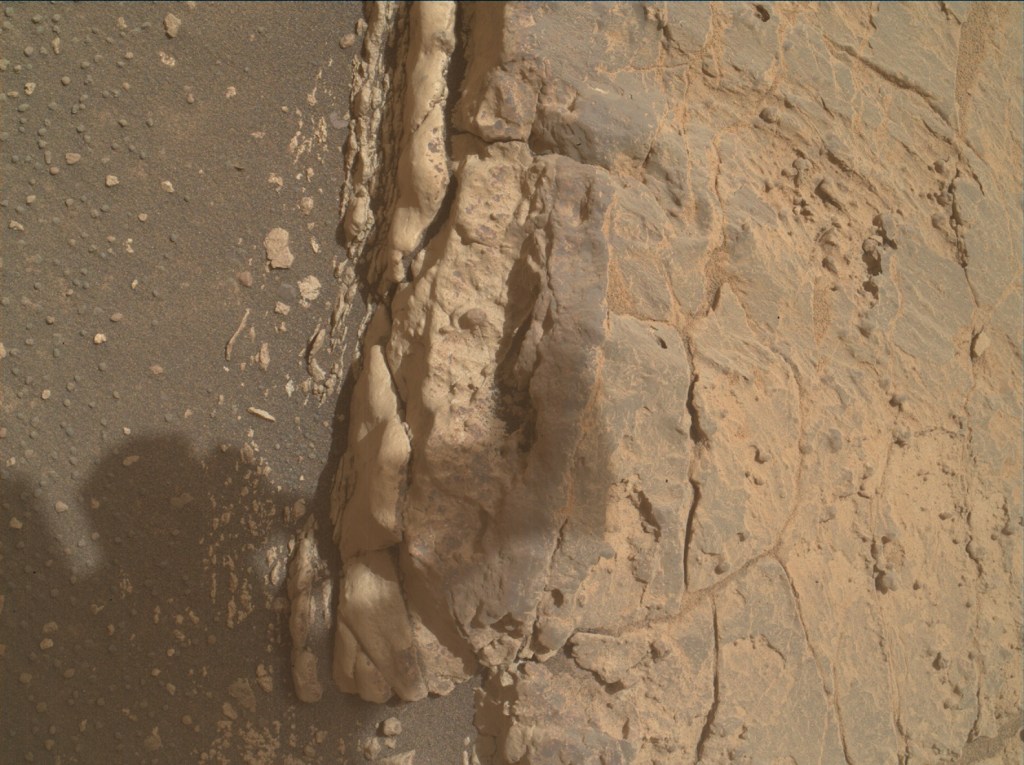
Coming back to our beautiful workspace, in this plan there is a focus on targeting the different colors and tones we can see in the bedrock with our suite of instruments. In the image above we can see some of these varying tones — including gray areas, lighter-toned areas, and areas of tan-colored bedrock — with an image from the MAHLI instrument, Curiosity’s onboard hand lens.

APXS is targeting “Campfire Lake,” a lighter-toned area, and “Gemini,” a more gray-toned area situated in front of the rover. MAHLI is taking a suite of close-up images of these targets too. ChemCam is then taking two LIBS measurements of “Crazy Lake” and “Foolish Lake,” both of which appear to have lighter tones. Mastcam is documenting this whole area with a workspace mosaic and an 8×2 mosaic of “Picture Puzzle,” named after the rock in the image above that was taken during the previous plan. Mastcam will also be capturing a 6×3 mosaic of an outcrop named “Outguard Spire” that has an interesting gray rim. Looking further afield, ChemCam has planned a long-distance RMI image of the yardang unit and Navcam is taking a suprahorizon movie and dust-devil survey for our continued observations of the atmosphere to round out this plan.

Written by Emma Harris, Graduate Student at Natural History Museum, London

Share

Details

Last Updated
Sep 05, 2024

Related Terms

Keep Exploring

Discover More Topics From NASA

Mars

Mars is the fourth planet from the Sun, and the seventh largest. It’s the only planet we know of inhabited…

All Mars Resources

Explore this collection of Mars images, videos, resources, PDFs, and toolkits. Discover valuable content designed to inform, educate, and inspire,…

Rover Basics

Each robotic explorer sent to the Red Planet has its own unique capabilities driven by science. Many attributes of a…

Mars Exploration: Science Goals

The key to understanding the past, present or future potential for life on Mars can be found in NASA’s four…


Acest titlu a fost scris de inteligență artificială Chat GPT, unele date pot fi incorecte. Pentru stirea originala, verificati sursa: Link catre sursa

Sursa si foto: NASA

 În plus, ar putea să-ți placă
Loading RSS Feed

Donează Știri din RO

Recomandari STIRIdinROMANIA.ro

Programul de lucrări la rețelele de apă Aquatim

La începutul săptămânii, Aquatim are programate mai multe lucrări. Astfel, marți, între orele 9-17, la intersecția străzilor Treboniu Laurian...

Read More...

Sunteți cu adevărat pregătiți pentru o relație de cuplu?

A fi pregătit pentru o relație nu ține de vârstă, de „momentul potrivit” sau de noroc, ci de un...

Read More...

Conformismul sau cum ni se spune la ce să ne gândim?

Conformismul social reprezintă un concept în studiul comportamentului uman, fiind definit ca tendința indivizilor de a adopta opiniile, atitudinile...

Read More...

Leave a reply:

Your email address will not be published.

CAPTCHA ImageChange Image

Acest site folosește Akismet pentru a reduce spamul. Află cum sunt procesate datele comentariilor tale.

Mobile Sliding Menu

stiri & ziare online