With the dress rehearsal completed during Apollo 10 in May 1969, only a few weeks remained until Apollo 11, the actual Moon landing mission to meet President Kennedy’s goal set in 1961. Apollo 11 astronauts Neil A. Armstrong, Michael Collins, and Edwin E. “Buzz” Aldrin and their backups James A. Lovell, William A. Anders, and Fred W. Haise entered the final phase of their training, rehearsing their mission in simulators and practicing for the lunar surface activities. Teams in Mission Control supported the simulations. A successful countdown demonstration cleared the way to start the actual countdown leading to launch. In the Pacific Ocean, U.S. Navy and NASA teams prepared for the recovery of the astronauts returning from the Moon, and for their postflight quarantine.
Apollo 10
After returning from their successful Moon landing dress rehearsal mission on May 26, 1969, Apollo 10 astronauts Thomas P. Stafford, John W. Young, and Eugene A. Cernan passed on their knowledge and lessons learned to the Apollo 11 Moon landing crew during postflight debriefs. On June 8, they accepted Emmy Awards on behalf of all Apollo crews for their television broadcasts from space, with special recognition for Apollo 10’s first use of color TV in space. On June 19, Stafford, Young, and Cernan returned to NASA’s Kennedy Space Center (KSC) in Florida to thank the employees there for getting them safely into orbit. On June 30, President Richard M. Nixon hosted them and their wives at a White House black tie dinner in their honor.
Left: Apollo 10 astronauts debrief their mission with the Apollo 11 astronauts. Middle: Apollo 10 astronauts John W. Young, left, Eugene A. Cernan, and Thomas P. Stafford hold their Emmy Awards. Right: At NASA’s Kennedy Space Center (KSC) in Florida, Stafford, left, Young, and Cernan hold photographs of their launch presented to them by KSC Launch Director Rocco A. Petrone.
Apollo 10 astronauts Thomas P. Stafford, left, John W. Young, and Eugene A. Cernan wave to employees as they ride in a convertible through NASA’s Kennedy Space Center in Florida.
Apollo 11
The document from NASA’s Office of Manned Space Flight stating Apollo 11’s primary objective.
On June 26, Samuel C. Phillips, Apollo Program Director, and George E. Mueller, Associate Administrator for Manned Space Flight at NASA Headquarters in Washington, D.C., signed the directive stating Apollo 11’s primary objective: perform a manned lunar landing and return. The focus of the crew’s training, and all the other preparatory activities happening across the agency, aimed at accomplishing that seemingly simple, yet in truth extremely complex and never before accomplished, task.
Left: Apollo 11 astronauts Neil A. Armstrong, left, and Edwin E. “Buzz” Aldrin in the Lunar Module simulator at NASA’s Kennedy Space Center (KSC) in Florida. Right: Apollo 11 astronaut Michael Collins in KSC’s Command Module simulator.
Apollo 11 Flight Directors Eugene F. Kranz, left, Glynn S. Lunney, Clifford E. Charlesworth, Milton L. Windler, and Gerald D. Griffin pose in Mission Control.
The final weeks leading up to the launch of their historic mission proved quite busy for Apollo 11 astronauts Armstrong, Collins, and Aldrin and their backups Lovell, Anders, and Haise, as well as the ground teams preparing their rocket and spacecraft for flight. To train for the different phases of their mission, the astronauts conducted many sessions in Command Module (CM) and Lunar Module (LM) simulators at both the Manned Spacecraft Center (MSC), now NASA’s Johnson Space Center in Houston, and at KSC. For many of these sessions, teams of operators in MSC’s Mission Control monitored their activities as they would during the actual mission. Flight Directors Eugene F. Kranz, left, Glynn S. Lunney, Clifford E. Charlesworth, Milton L. Windler, and Gerald D. Griffin led the Mission Control teams.
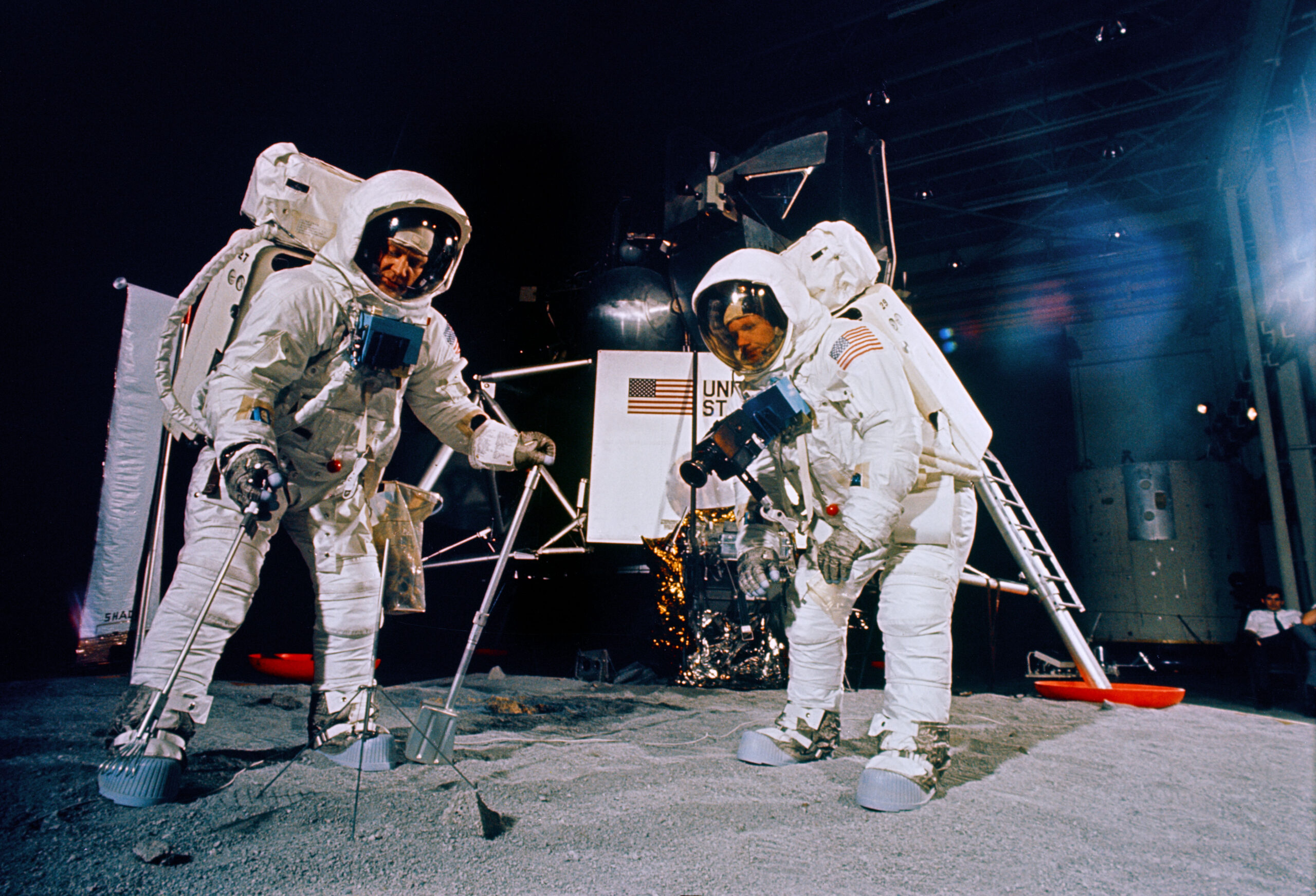
Apollo 11 astronauts Neil A. Armstrong, left, and Edwin E. “Buzz” Aldrin practice their lunar surface activities at the Manned Spacecraft Center, now NASA’s Johnson Space Center in Houston, left, and at NASA’s Kennedy Space Center in Florida.
Apollo 11 would conduct the first spacewalk on another celestial body and only the second spacewalk of the Apollo program. At training facilities at MSC and KSC, Armstrong and Aldrin practiced setting up a television camera that would relay their activities back to Earth during the 2.5-hour excursion, deploying the three science experiments, and collecting rock and regolith samples for return to Earth.
Left: Apollo 11 Commander Neil A. Armstrong prepares to fly the Lunar Landing Training Vehicle (LLTV) at Ellington Air Force Base in Houston. Middle: Armstrong airborne in the LLTV. Right: Apollo 11 backup Commander James A. Lovell following a flight in the LLTV.
On June 6, NASA managers approved the resumption of astronaut training flights in the Lunar Landing Training Vehicle (LLTV) at Ellington Air Force Base (AFB) near MSC. The LLTV simulated the flight characteristics of the LM and astronauts used it to train for the final 200 feet of the descent to the lunar surface. Managers reached the decision after reviewing findings from the Review Board headed by astronaut Walter M. Schirra that investigated the Dec. 8, 1968 crash of LLTV-1 as well as results from flights in LLTV-2 made by MSC test pilots Harold E. “Bud” Ream and Jere B. Cobb. Between June 14 and 16, Armstrong flew LLTV-2 eight times to complete his training program with the vehicle. He had previously completed 12 simulated Moon landings in the LLTV and its predecessor, the Lunar Landing Research Vehicle (LLRV), narrowly escaping the crash of LLRV-1 in May 1968. Backup Commander Lovell completed four flights in the LLTV between June 19 and July 1. Armstrong, Aldrin, Lovell, and Haise also practiced landings in the Lunar Landing Research Facility (LLRF) at NASA’s Langley Research Center in Hampton, Virginia.
Left: Senior NASA managers monitor the Apollo 11 Countdown Demonstration Test (CDDT) in Firing Room 1 of the Launch Control Center at NASA’s Kennedy Space Center. Right: The team of controllers in Firing Room 1 monitor the Apollo 11 CDDT.
Left: Apollo 11 astronauts Neil A. Armstrong, front, Michael Collins, and Edwin E. “Buzz” Aldrin about to board the transfer van to Launch Pad 39A for the Countdown Demonstration Test (CDDT). Middle: Workers in the White Room assist Collins, left, Armstrong, and Aldrin to enter their spacecraft for the CDDT. Right: Armstrong, left, Aldrin, and Collins leave Launch Pad 39A at the conclusion of the CDDT.
At KSC, engineers completed the three-day Flight Readiness Test on June 6, ensuring the flight readiness of the Saturn V rocket and the Apollo spacecraft perched on Launch Pad 39A. On June 17, top managers from NASA Headquarters and the Directors of MSC, KSC, and the Marshall Space Flight Center in Huntsville, Alabama, held the Flight Readiness Review at KSC. The meeting reviewed all aspects of readiness for the launch and mission, clearing the way for the next milestone, the Countdown Demonstration Test (CDDT). The CDDT, a full dress rehearsal for the actual countdown to launch, consisted of two parts. The “wet” test, conducted from June 27 to July 2, included fueling the rocket as if for flight, with the countdown stopping just prior to first stage engine ignition, and did not involve the flight crew. The “dry” test followed on July 3, an abbreviated countdown without fueling the rocket but with the astronauts boarding the CM as if on launch day. Controllers in Firing Room 1 of the Launch Control Center at Launch Complex 39 monitored all aspects of the CDDT as they would for an actual countdown. The successful test cleared the way for the start of the launch countdown at 8 p.m. EDT on July 10, leading to launch on July 16.
The three commemorative items carried aboard Apollo 11. Left: The Lunar Flag Assembly. Middle: The stainless steel commemorative plaque. Right: The silicon disc containing messages of goodwill from world leaders.
On July 2, NASA announced that Armstrong and Aldrin would leave three symbolic items behind on the Moon to commemorate the historic first landing – an American flag, a commemorative plaque, and a silicon disc bearing messages from world leaders. The astronauts would plant the three-by-five-foot flag near their LM during their spacewalk. The stainless steel plaque bore the images of the two hemispheres of the Earth and this inscription,
HERE MEN FROM THE PLANET EARTH
FIRST SET FOOT UPON THE MOON
JULY 1969 A.D.
WE CAME IN PEACE FOR ALL MANKIND
The signatures of the three astronauts and President Richard M. Nixon also appeared on the plaque. Workers mounted it on the forward landing leg strut of the LM. The one-and-one-half-inch silicon disc contained messages of goodwill from 73 world leaders, etched on the disk using the technique to make microcircuits for electronic equipment. The crew placed the disc on the lunar surface at the end of their spacewalk.
Left: Apollo 11 astronauts Neil A. Armstrong, left, Edwin E. “Buzz” Aldrin, and Michael Collins hold a copy of the commemorative plaque they will leave behind on the Moon and their mission patch. Right: The Apollo 11 astronauts in the glass-enclosed room at the Lunar Receiving Laboratory.
During a July 5 press conference in the MSC auditorium, the Apollo 11 astronauts revealed the call signs for their spacecraft. They named their CM Columbia and their LM Eagle. “We selected these as being representative of the flight, the nation’s hope,” said Armstrong. Columbia served as a national symbol represented by a statue atop the Capitol in Washington, D.C. They named the LM after the symbol of the United States, the bald eagle, featured on the Apollo 11 mission patch. In a second event, the astronauts answered reporters’ questions from inside a glass-enclosed conference room at MSC’s Lunar Receiving Laboratory (LRL). After their mission, the returning astronauts completed their 21-day quarantine in the LRL to prevent any back contamination of the Earth by any possible lunar microorganisms.
NASA’s Johnson Space Center in Houston, workers simulate the arrival of the first Moon rocks and other items returned from Apollo 11. Middle: Workers practice docking the Mobile Quarantine Facility (MQF) with the LRL. Right: In Pearl Harbor, Hawaii, workers barge the prime and backup MQFs to load them onto the U.S.S. Hornet. Image credit: courtesy U.S. Navy.
At the LRL, other preparations for the return of the Apollo 11 astronauts from the Moon included a simulation of the arrival and processing of the Moon rocks and other items following the mission. The rocks, crew biological samples, and film would be flown from the prime recovery ship to Houston ahead of the crew. Engineers and technicians also rehearsed the arrival of the crew with a dry run of docking a Mobile Quarantine Facility (MQF) to the LRL’s loading dock. Following the test, workers loaded two MQFs, a prime and a backup, onto a cargo plane for transport to Hawaii and loading onto the prime recovery ship.
Left: Workers in Pearl Harbor, Hawaii, prepare to lift a boilerplate Apollo Command Module onto the U.S.S. Hornet for splashdown and recovery rehearsals. Image credit: courtesy U.S. Navy Bob Fish. Middle: Crews from the U.S.S. Hornet practice recovery operations. Right: Recovery team members dry their Biological Isolation Garments aboard the U.S.S. Hornet following a recovery exercise.
On June 12, the U.S. Navy notified NASA that it had selected the U.S.S. Hornet (CVS-12) as the prime recovery ship for Apollo 11 to undertake the most complex recovery of an astronaut crew. The same day, with Hornet docked in her home port of Long Beach, California, its commanding officer, Capt. Carl J. Seiberlich, held the first recovery team meeting to review the Apollo Recovery Operations Manual, written by MSC’s Landing and Recovery Division. Between June 12 and 25, Hornet onloaded NASA equipment required for the recovery. On June 27, Hornet left Long Beach for a three-hour stop in San Diego, where air group maintenance and support personnel embarked. The next day, after Hornet left for Pearl Harbor, Hawaii, pilots flew the aircraft required to support the recovery onto the carrier. During the cruise to Pearl Harbor, Hornet’s 90-man team detailed for Apollo 11 recovery operations held numerous meetings and table-top simulations. After arriving in Hawaii on July 2, workers loaded a boilerplate Apollo capsule onto the aircraft carrier to be used for recovery practice. The NASA recovery team, the Frogmen swimmers from the U.S. Navy’s Underwater Demolition Team 11 (UDT-11) who assisted with the recovery, and some media personnel arrived onboard. For the recovery operation, Capt. Seiberlich adopted the motto “Hornet Plus Three,” indicating the goal of a safe recovery of the three astronauts returning from the Moon. On July 3, Capt. Seiberlich introduced the 35-member NASA recovery team to the Hornet’s crew. Donald E. Stullken, Chief of the Recovery Operations Branch at MSC and inventor of the inflatable flotation collar attached by swimmers to the capsule after splashdown, led the NASA team. His assistant John C. Stonesifer oversaw the decontamination and quarantine operations. Stullken and Stonesifer briefed Hornet’s Command Module Retrieval Team on all events associated with the recovery and retrieval of an Apollo capsule and its crew. On July 6, workers loaded the two MQFs aboard Hornet. The prime MQF would house the returning astronauts, a flight surgeon, and an engineer from shortly after splashdown until their arrival at the LRL in Houston several days later. The second MQF served as a backup should a problem arise with the first or if violations of quarantine protocols required additional personnel to be isolated. Along with the MQFs, Navy personnel loaded other equipment necessary for the recovery, including 55 one-gallon containers of sodium hypochlorite to be used as a disinfectant. Between July 7 and 9, the Hornet conducted nine Simulated Recovery Exercises in local Hawaiian waters. Lieutenant Clarence J. “Clancy” Hatleberg led the team as the designated decontamination swimmer with U.S. Navy Frogmen serving as stand-ins for the astronauts, all wearing Biological Isolation Garments as they would on recovery day. The Hornet returned to Pearl Harbor to pick up the rest of the NASA recovery team before setting sail on July 12 for its first recovery position.
Apollo 12
Left: Apollo 12 astronauts Charles “Pete” Conrad, left, Alan L. Bean, and Richard F. Gordon prepare to enter their Command Module for an altitude test. Right: Conrad after completing a flight in the Lunar Landing Training Vehicle.
Left: In the Manned Spacecraft Operations Building (MSOB) at NASA’s Kennedy Space Center, workers finish attaching the landing gear to the Apollo 12 Lunar Module (LM). Middle left: Workers in the MSOB prepare to mate the Apollo 12 Command and Service Modules with the Spacecraft LM Adapter. Middle right: Workers move the assembled Apollo 12 spacecraft from the MSOB to the Vehicle Assembly Building (VAB). Right: In the VAB. workers lower the Apollo 12 spacecraft onto its Saturn V rocket.
With Apollo 11 on its launch pad, workers continued to prepare Apollo 12 for its eventual journey to the Moon, targeting a September launch should Apollo 11 not succeed. If Apollo 11 succeeded in its Moon landing mission, Apollo 12 would fly later, most likely in November, to attempt the second Moon landing at a different location. In KSC’s Vehicle Assembly Building (VAB), the three-stage Saturn V stood on its Mobile Launcher, awaiting the arrival of the Apollo spacecraft. In the nearby Manned Spacecraft Operations Building, the Apollo 12 prime crew of Charles “Pete” Conrad, Richard F. Gordon, and Alan L. Bean and their backups David R. Scott, Alfred M. Worden, and James B. Irwin completed altitude chamber tests of the CM and LM during the first two weeks of June. Workers removed the spacecraft from the vacuum chambers, mated them on June 27, and transferred them to the VAB on July 1 for stacking on the Saturn V rocket. At Ellington AFB in Houston, Conrad completed his first flights aboard LLTV-2 on July 9-10.
Apollo 13
Left: In the Vehicle Assembly Building at NASA’s Kennedy Space Center (KSC) in Florida, workers place the first stage of the Apollo 13 Saturn V rocket onto the Mobile Launcher to begin the stacking process. Middle: The Apollo 13 Command and Service Modules arrive at KSC. Right: The ascent stage of the Apollo 13 Lunar Module arrives at KSC.
In the event that neither Apollo 11 nor 12 succeeded in landing on the Moon, NASA stood prepared to try a third time with Apollo 13 in November or December, still in time to meet President Kennedy’s deadline. The Apollo 13 Command and Service Modules arrived at KSC on June 26, followed by the LM ascent and descent stages on June 28 and 29, respectively. The Saturn V’s S-IC first stage arrived on June 16 and workers placed it on its Mobile Launcher two days later. The S-IVB third stage and S-II second stage arrived June 13 and 29, respectively, and workers stacked the stages in mid-July.
To be continued …
News from around the world in June 1969:
June 3 – Eric Carle publishes children’s picture book “The Very Hungry Caterpillar.”
June 3 – The final episode of Star Trek airs on NBC.
June 5 – The Tupolev Tu-144 became the first passenger jet to fly faster than the speed of sound.
June 10 – The Nixon Administration cancels the U.S. Air Force Manned Orbiting Laboratory program.
June 15 – “Hee Haw,” with Roy Clark and Buck Owens, premieres on CBS.
June 20 – Georges Pompidou sworn in as the 19th President of France.
June 20 – 200,000 attend Newport ’69, then largest-ever pop concert, in Northridge, California.
June 23 – Warren E. Burger sworn in as U.S. Supreme Court Chief Justice.
June 28 – Police carry out a raid at the Stonewall Inn in Greenwich Village, New York, beginning the modern LGBT rights movement.