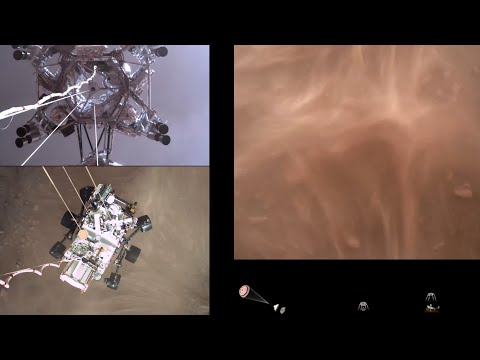
NASA a sărbătorit aniversarea a 12 ani de când roverul Curiosity a aterizat pe Planeta Roșie, încercând noi tehnologii îndrăznețe pentru a aduce cu succes știința pe Marte. În urmă cu 12 ani, pe 5 august 2012, Curiosity a ajuns pe Marte folosind o manevră inedită: manevra cu frânghie din spațiu.
Această manevră a implicat un jetpack robotic care a livrat roverul Curiosity la locul de aterizare și l-a coborât pe suprafață cu ajutorul unor frânghii din nylon, apoi a tăiat frânghiile și a zburat pentru a ateriza controlat într-o zonă sigură, departe de rover.
În timpul aterizării roverului Perseverance în februarie 2021, tehnologia sky crane a fost îmbunătățită, permițându-i roverului de dimensiunea unui SUV să aterizeze în siguranță pe un vechi lac de pe Marte plin de roci și cratere.
Aceste tehnologii sunt rezultatul unor eforturi susținute de la NASA și Jet Propulsion Laboratory (JPL) pentru a inova și a aduce mai multă precizie în aterizările pe alte planete. De-a lungul anilor, JPL a fost implicat în multiple misiuni de aterizare pe Marte, începând cu misiunea Viking din 1976 și continuând cu Pathfinder, Spirit și Opportunity.
Manevra sky crane a fost concepută din necesitate, deoarece roverul Curiosity era prea mare și prea greu pentru aterizarea cu airbags, ca predecesorii săi. Această tehnică a adus o precizie mai mare și a permis aterizări în locații mai interesante științific.
Pentru viitor, această tehnologie are potențialul de a fi folosită și în alte locații din sistemul solar, precum Luna sau alte planete. Inovația din spatele manevrei sky crane deschide noi posibilități pentru explorarea spațiului și aduce ideea unui serviciu de livrare de încărcături pe alte planete mai aproape de realitate.
Cu fiecare nouă misiune pe Marte, NASA și JPL demonstrează că tehnologia și inovația pot duce știința și explorarea spațială la noi înălțimi. Acest progres continuu este esențial pentru a înțelege mai bine universul în care trăim și pentru a pregăti calea pentru viitoarele misiuni spațiale.
Twelve years ago, NASA landed its six-wheeled science lab using a daring new technology that lowers the rover using a robotic jetpack.
NASA’s Curiosity rover mission is celebrating a dozen years on the Red Planet, where the six-wheeled scientist continues to make big discoveries as it inches up the foothills of a Martian mountain. Just landing successfully on Mars is a feat, but the Curiosity mission went several steps further on Aug. 5, 2012, touching down with a bold new technique: the sky crane maneuver.
A swooping robotic jetpack delivered Curiosity to its landing area and lowered it to the surface with nylon ropes, then cut the ropes and flew off to conduct a controlled crash landing safely out of range of the rover.
Of course, all of this was out of view for Curiosity’s engineering team, which sat in mission control at NASA’s Jet Propulsion Laboratory in Southern California, waiting for seven agonizing minutes before erupting in joy when they got the signal that the rover landed successfully.
The sky crane maneuver was born of necessity: Curiosity was too big and heavy to land as its predecessors had — encased in airbags that bounced across the Martian surface. The technique also added more precision, leading to a smaller landing ellipse.
During the February 2021 landing of Perseverance, NASA’s newest Mars rover, the sky crane technology was even more precise: The addition of something called terrain relative navigation enabled the SUV-size rover to touch down safely in an ancient lake bed riddled with rocks and craters.
Watch as NASA’s Perseverance rover lands on Mars in 2021 with the same sky crane maneuver Curiosity used in 2012. Credit: NASA/JPL-Caltech
JPL has been involved in NASA’s Mars landings since 1976, when the lab worked with the agency’s Langley Research Center in Hampton, Virginia, on the two stationary Viking landers, which touched down using expensive, throttled descent engines.
For the 1997 landing of the Mars Pathfinder mission, JPL proposed something new: As the lander dangled from a parachute, a cluster of giant airbags would inflate around it. Then three retrorockets halfway between the airbags and the parachute would bring the spacecraft to a halt above the surface, and the airbag-encased spacecraft would drop roughly 66 feet (20 meters) down to Mars, bouncing numerous times — sometimes as high as 50 feet (15 meters) — before coming to rest.
It worked so well that NASA used the same technique to land the Spirit and Opportunity rovers in 2004. But that time, there were only a few locations on Mars where engineers felt confident the spacecraft wouldn’t encounter a landscape feature that could puncture the airbags or send the bundle rolling uncontrollably downhill.
“We barely found three places on Mars that we could safely consider,” said JPL’s Al Chen, who had critical roles on the entry, descent, and landing teams for both Curiosity and Perseverance.
It also became clear that airbags simply weren’t feasible for a rover as big and heavy as Curiosity. If NASA wanted to land bigger spacecraft in more scientifically exciting locations, better technology was needed.
In early 2000, engineers began playing with the concept of a “smart” landing system. New kinds of radars had become available to provide real-time velocity readings — information that could help spacecraft control their descent. A new type of engine could be used to nudge the spacecraft toward specific locations or even provide some lift, directing it away from a hazard. The sky crane maneuver was taking shape.
JPL Fellow Rob Manning worked on the initial concept in February 2000, and he remembers the reception it got when people saw that it put the jetpack above the rover rather than below it.
“People were confused by that,” he said. “They assumed propulsion would always be below you, like you see in old science fiction with a rocket touching down on a planet.”
Manning and colleagues wanted to put as much distance as possible between the ground and those thrusters. Besides stirring up debris, a lander’s thrusters could dig a hole that a rover wouldn’t be able to drive out of. And while past missions had used a lander that housed the rovers and extended a ramp for them to roll down, putting thrusters above the rover meant its wheels could touch down directly on the surface, effectively acting as landing gear and saving the extra weight of bringing along a landing platform.
But engineers were unsure how to suspend a large rover from ropes without it swinging uncontrollably. Looking at how the problem had been solved for huge cargo helicopters on Earth (called sky cranes), they realized Curiosity’s jetpack needed to be able to sense the swinging and control it.
“All of that new technology gives you a fighting chance to get to the right place on the surface,” said Chen.
Best of all, the concept could be repurposed for larger spacecraft — not only on Mars, but elsewhere in the solar system. “In the future, if you wanted a payload delivery service, you could easily use that architecture to lower to the surface of the Moon or elsewhere without ever touching the ground,” said Manning.
More About the Mission
Curiosity was built by NASA’s Jet Propulsion Laboratory, which is managed by Caltech in Pasadena, California. JPL leads the mission on behalf of NASA’s Science Mission Directorate in Washington.
For more about Curiosity, visit:
science.nasa.gov/mission/msl-curiosity
Andrew Good Jet Propulsion Laboratory, Pasadena, Calif. 818-393-2433 andrew.c.good@jpl.nasa.gov
Karen Fox / Alana Johnson NASA Headquarters, Washington 202-358-1600 karen.c.fox@nasa.gov / alana.r.johnson@nasa.gov
2024-104
Acest titlu a fost scris de inteligență artificială Chat GPT, unele date pot fi incorecte. Pentru stirea originala, verificati sursa: Link catre sursa
Precizări: Legea 190 din 2018, la articolul 7, menţionează că activitatea jurnalistică este exonerată de la unele prevederi ale Regulamentului GDPR, dacă se păstrează un echilibru între libertatea de exprimare şi protecţia datelor cu caracter personal.
Mai multe gasiti pe pagina de Facebook stiridinromania.ro!
Daca ati fost martorii unui eveniment sau ai unei situatii neobisnuite care ar putea deveni subiect de stire, contactati-ne la admin @ stiridinromania.ro sau pe contul nostru de Facebook stiridinromania.ro!
Institutul de Istorie „A. D. Xenopol”, Academia Română, Filiala Iași
în parteneriat cu
Muzeul Județean Botoșani
Consiliul Județean Botoșani
Dr. Sorin GRIGORUȚĂ, CS...
Institutul de Istorie „A. D. Xenopol”, Academia Română, Filiala Iași
în parteneriat cu
Muzeul Județean Botoșani
Consiliul Județean Botoșani
Dr. Sorin GRIGORUȚĂ, CS...
Bună dimineața, iată cele mai recente evoluții ale conflictului din Orientul Mijlociu.Declarații contradictorii legate de presupuse negocieri de pace....
O particularitate majoră care face sectorul construcțiilor atractiv este existența încasărilor mari. O înființare inteligentă de firmă construcții /...
Domnului Prim-Ministru, Ilie Bolojan, domnului Viceprim-Ministru, Marian Neacșu, domnului Alexandru Nazare
Ministrul Finanțelor
În temeiul Legii nr. 544/2001 privind liberul acces...
Folosim tehnologii precum cookie-urile pentru a stoca și/sau accesa informații despre dispozitiv. Facem acest lucru pentru a îmbunătăți experiența de navigare și pentru a afișa anunțuri personalizate. Consimțământul pentru aceste tehnologii ne va permite să procesăm date precum comportamentul de navigare sau ID-uri unice pe acest site. Neconsimțământul sau retragerea consimțământului pot afecta negativ anumite caracteristici și funcții.
Funcționale
Mereu activ
Stocarea tehnică sau accesul sunt strict necesare în scopul legitim de a permite utilizarea unui anumit serviciu cerut în mod explicit de către un abonat sau un utilizator sau în scopul exclusiv de a executa transmiterea unei comunicări printr-o rețea de comunicații electronice.
Preferințe
Stocarea tehnică sau accesul este necesară în scop legitim pentru stocarea preferințelor care nu sunt cerute de abonat sau utilizator.
Statistici
Stocarea tehnică sau accesul care sunt utilizate exclusiv în scopuri statistice.Stocarea tehnică sau accesul care sunt utilizate exclusiv în scopuri statistice anonime. Fără o citație, conformitatea voluntară din partea Furnizorului tău de servicii de internet sau înregistrările suplimentare de la o terță parte, informațiile stocate sau preluate numai în acest scop nu pot fi utilizate de obicei pentru a te identifica.
Marketing
Stocarea tehnică sau accesul sunt necesare pentru a crea profiluri de utilizator pentru a trimite publicitate sau pentru a urmări utilizatorul pe un site web sau pe mai multe site-uri web în scopuri de marketing similare.
Folosim tehnologii precum cookie-urile pentru a stoca și/sau accesa informații despre dispozitiv. Facem acest lucru pentru a îmbunătăți experiența de navigare și pentru a afișa anunțuri personalizate. Consimțământul pentru aceste tehnologii ne va permite să procesăm date precum comportamentul de navigare sau ID-uri unice pe acest site. Neconsimțământul sau retragerea consimțământului pot afecta negativ anumite caracteristici și funcții.